

Generator sizing is usually done backwards – people pick a wattage that sounds reassuring, then discover it will not start the well pump. Work it the other way: list what must run, add the starting surge, and buy above that.
Running watts versus starting watts
Anything with an electric motor – fridge, well pump, air conditioner, furnace blower – draws a large surge for a second or two when it kicks in, often two to three times its running draw. A fridge that runs at 200 watts may need 1,200 to start.
Generators quote both numbers. Size the running watts to your total load and make sure the starting watts cover your single largest motor starting while everything else is already running. Miss this and the generator trips constantly.
Typical household loads
- Refrigerator – 200 W running, ~1,200 W starting
- Sump pump – 800 W running, ~2,000 W starting
- Well pump (1/2 hp) – 1,000 W running, ~3,000 W starting
- Furnace blower – 600 W running, ~1,800 W starting
- Lights, phones, router – 300 W total
- Window AC – 1,200 W running, ~2,500 W starting
Matching a machine to the job
1,000–2,000 W. Phones, laptop, a lamp, a CPAP. Camping and tailgating. A battery power station like the Westinghouse iGen1000S runs silently and indoors safely, which a fuel generator never does.
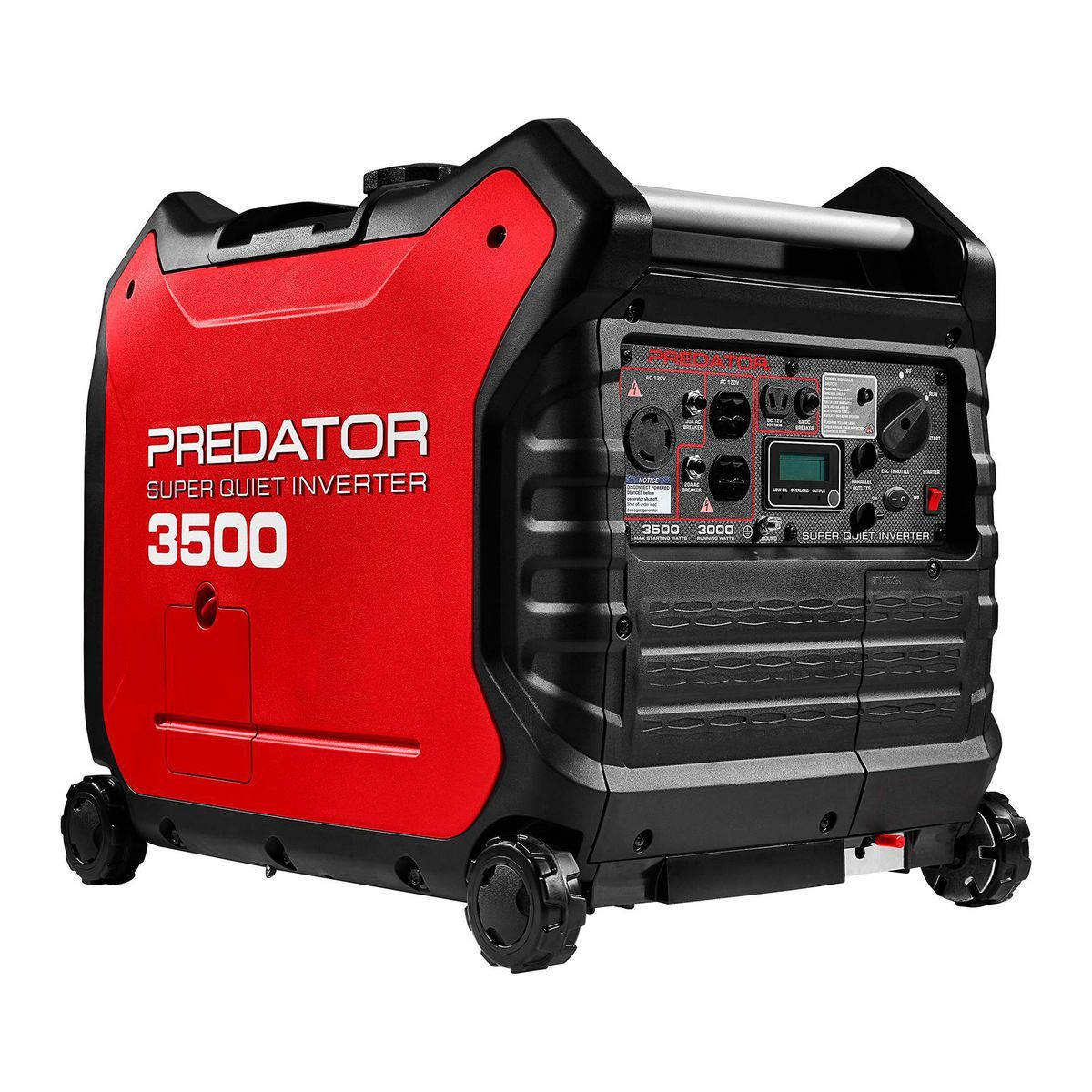
3,000–4,000 W. The realistic minimum for a useful home backup: fridge, lights, furnace blower, internet, and a few outlets. Inverter models such as the Predator 3500 are quiet enough not to annoy the neighbours through a long outage.
5,000–8,000 W. Adds a well pump or sump pump and more of the house at once. This is where most rural households land.
9,000 W and up. Approaching whole-house on a transfer switch.
Standby systems. A permanently installed unit like the Kohler 20kW runs on natural gas or propane, starts itself within seconds of an outage and needs no fuel handling. It is a different category – professional installation, a transfer switch, and a permit – but if outages are frequent it is the answer.
Inverter or conventional?
Inverter generators produce cleaner power (low total harmonic distortion), which matters for laptops, TVs and modern appliance control boards. They also throttle down under light load, so they are far quieter and use less fuel.
Conventional generators run at a constant speed and cost less per watt. Fine for power tools and pumps, less ideal for electronics.
For home backup, inverter is usually worth the difference – you will be living beside it.
Dual fuel is worth it
A dual-fuel model runs on petrol or propane. Propane stores indefinitely without going stale, which is the real advantage – petrol degrades in months and a generator that will not start in an outage is just a heavy box. Output on propane is typically slightly lower, so size accordingly.
Carbon monoxide: the part that kills people
This is not a footnote. Portable generators produce carbon monoxide in lethal concentrations, and CO poisoning during power outages kills dozens of Americans every year.
- Never run a generator indoors, in a garage, in a basement, or in a crawl space – open doors and windows do not make it safe.
- Place it at least 20 feet from the house, with the exhaust directed away from doors, windows and vents.
- Fit working CO alarms on every level of your home.
- Buy a model with automatic CO shutoff where you can – several current Generac and Predator units include it.
Never backfeed a generator into a wall socket to power your house. It can electrocute utility workers repairing your line. Use a properly installed transfer switch or an interlock kit.
Runtime and fuel
Quoted runtime is usually at 25–50% load. At full load, halve it. For a multi-day outage, work out how much fuel you can safely store and rotate – and note that petrol stations need power to pump.
Browse the range
See all 35 in Portable Generators – inverter, dual-fuel, conventional and standby systems, shipped free across the lower 48.
Tell us what you need to keep running and we will size it with you.