

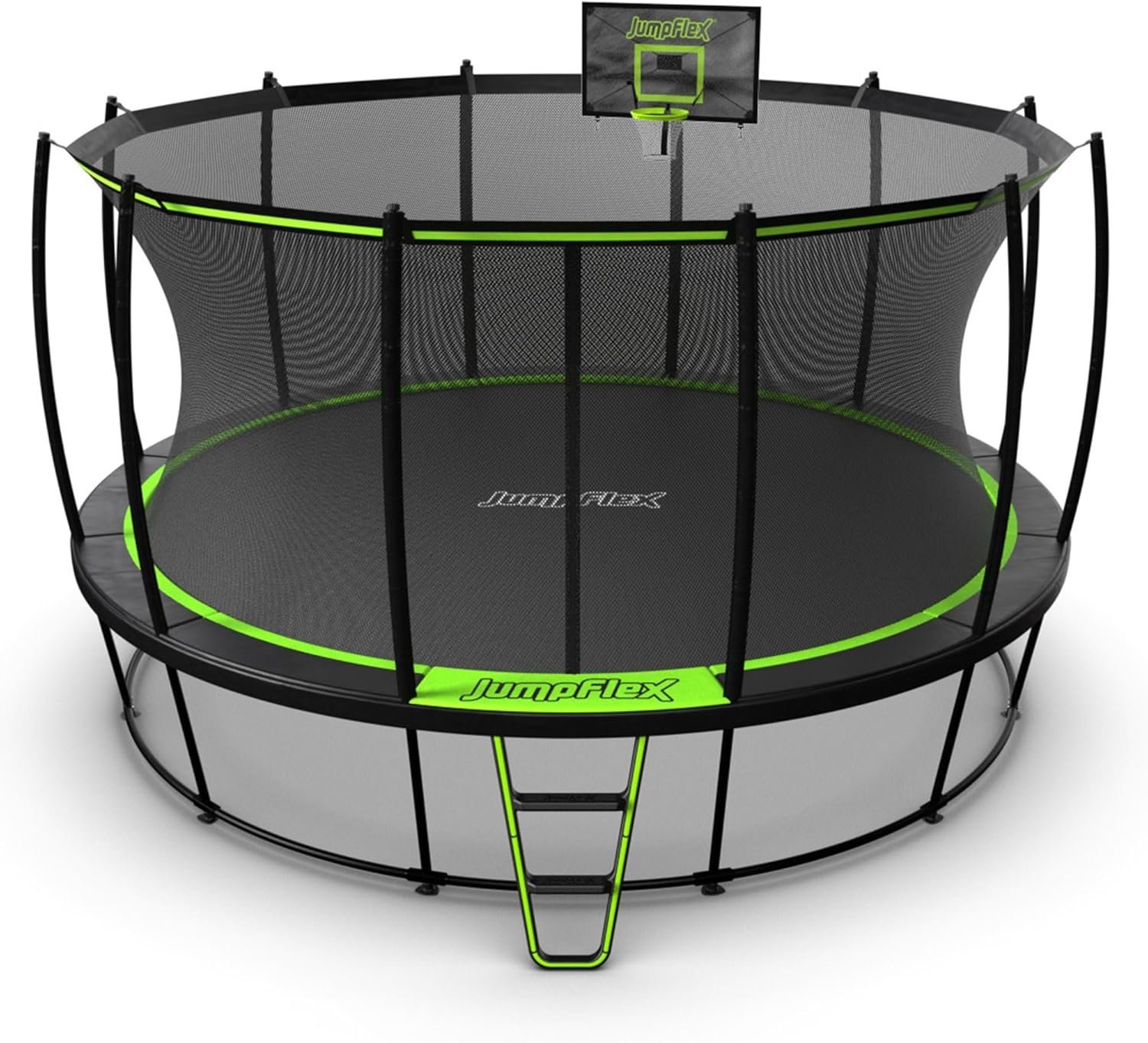
Trampolines are one of the few backyard purchases where the safety specification and the buying decision are the same conversation. Get the size, the net and the placement right and they are among the best value play equipment you can buy. Get them wrong and the emergency room statistics are not encouraging.
Size by who is jumping, and by your yard
- 8 ft – one small child. Suits compact gardens.
- 10 ft – one to two children. The usual choice for a standard suburban yard.
- 12 ft – two children comfortably, or a teenager.
- 14 to 15 ft – multiple jumpers and adults. The JumpFlex HERO 14 and HERO 15 sit here.
Bigger is generally safer, not less safe – more mat area means more room to land away from the edge. The constraint is your garden, not the jumper.
Clearance is the specification people skip
Leave at least 6 feet of clear space on every side and roughly 24 feet of clearance overhead. That means away from fences, washing lines, walls, and especially away from overhanging branches.
Never place a trampoline on concrete, decking or paving. Level grass is the right surface, and level matters – a frame on a slope puts uneven load through the legs and shifts the bounce toward the low side.
Weight rating is about the frame, not the jumper
The quoted weight limit reflects what the frame and springs can absorb, and a jumper generates several times their body weight on landing. A 75 lb child can load the mat with 300 lb of force.
Treat the rating as a hard limit, and size up if adults will use it. Frames that exceed their rating do not usually fail dramatically – they sag, and the bounce becomes unpredictable, which is its own hazard.
Look for ASTM compliance
ASTM F381 is the US consumer trampoline safety standard, covering frame strength, net integrity, padding and labelling. A compliant model such as the Giantex ASTM-approved range has been tested against it.
It is not a legal requirement, which is exactly why it is worth checking. Cheap unbranded imports frequently are not compliant, and the difference shows up in the net attachment and the spring cover.
The enclosure is not optional
Falls from the trampoline account for a large share of serious injuries. A net is the single most effective safety feature, and the design matters:
- Net inside the springs – the jumper cannot land on the frame or springs at all. This is the safer arrangement.
- Net outside the frame – leaves the springs exposed within the jumping area, relying on the pad alone.
Check the poles are padded and that the net closes with a zip and a clip, not just an overlap. The ALLSTAR 10 ships with net and ladder together, which is how they should be bought.
Springs or springless
Traditional steel springs give a deeper, bouncier feel and cost less. Springless designs using fibreglass rods remove the pinch points entirely – a genuine safety gain for young children, at a higher price and with a slightly firmer bounce.
The rules that prevent most injuries
Equipment matters less than use. Paediatric guidance is consistent on these:
- One jumper at a time. Most fractures happen when a smaller child is bounced by a larger one – the double-bounce effect can multiply landing force several times over.
- No somersaults or flips. Head and neck injuries are the catastrophic ones.
- Supervision for under-sixes, and many paediatricians advise against trampoline use under six entirely.
- Remove the ladder when not in use, so toddlers cannot climb up unsupervised.
- Check monthly – spring tension, net tears, pad condition, frame rust at the leg joints.
Winter and wind
A trampoline is a large, light sail. Anchor kits are inexpensive and stop it crossing your garden in a storm. In heavy snow regions, remove the mat and net over winter – snow load stretches mats and UV-degraded nets tear.
Browse the range
See what we stock in Trampolines, all supplied with enclosure and ladder, delivered free across the lower 48.
Tell us your yard dimensions and the ages of the children, and we will tell you which size fits safely – including if it does not.