

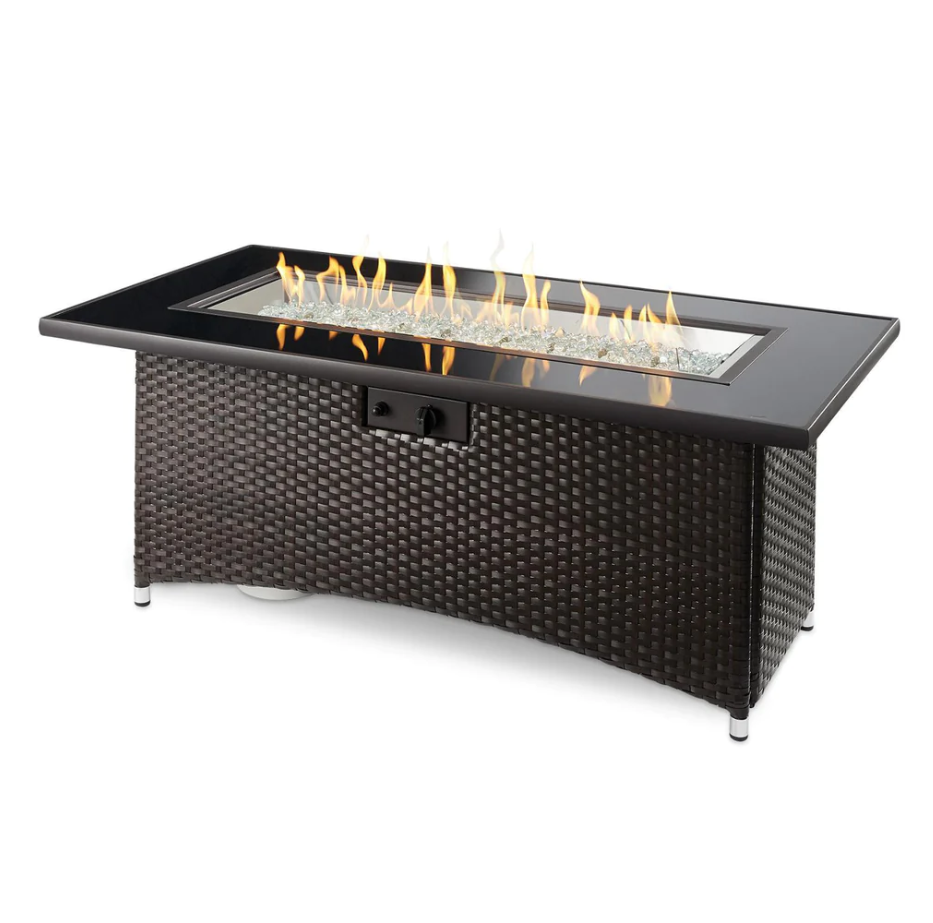
A gas fire pit table gives you flame on demand with no smoke, no ash and no wood pile – and unlike a wood fire, you can put drinks on it. The decisions that matter are fuel, BTU, and where you are legally and safely allowed to put it.
Propane or natural gas?
Propane runs from a 20 lb tank concealed in the table base. No installation, and you can move the table. A tank gives roughly 8 to 12 hours at a typical burn rate, so plan on refills through a season. The Outdoor GreatRoom Montego 59″ is a propane example.
Natural gas never runs out and costs far less to run, but needs a gas line trenched to the spot – a plumber job, usually permitted, and it fixes the table in place permanently.
If you know exactly where the table will live for the next decade, natural gas pays for itself. Otherwise propane.
What BTU actually buys
BTU on a fire pit is mostly about flame presence, not heating a space – outdoors, most of the heat goes up.
- Under 40,000 BTU – decorative. Pleasant flame, little warmth.
- 40,000–60,000 BTU – the usual range. Noticeable warmth for people seated close on a cool evening.
- Over 60,000 BTU – large linear burners, mainly about the look across a long table like the 84″ Del Mar concrete pit.
If warmth is the actual goal rather than atmosphere, a patio heater does it far more efficiently.
Clearances – the part that causes fires
These numbers are not conservative padding:
- 10 feet minimum from your house, fence, shed or any structure. Many jurisdictions and most HOAs require exactly this.
- Never under a covered patio, pergola with a solid roof, awning or umbrella. Heat and combustion products collect against the ceiling. This is the single most common serious mistake.
- Clear overhead – no branches, no wires.
- Keep furniture at least 2 to 3 feet back from the burner edge.
Check your local fire code and HOA rules before buying. Some municipalities restrict open flame entirely during fire season, and in parts of the western US that is a large part of the year.
Surfaces and placement
Put it on concrete, pavers, stone or bare ground. Composite decking can soften under radiant heat and wood decking needs a protective pad. Never place one on grass you care about, or on anything that can shift – a table that tips while lit is the worst case.
Level matters for more than looks: an out-of-level burner pan pools condensation and burns unevenly.
Media: glass, lava rock or logs
The material over the burner is not decoration alone – it diffuses the flame and protects the burner.
Fire glass reflects light, produces no dust and lasts indefinitely. Lava rock is cheaper, more natural looking, and needs occasional replacement as it breaks down. Ceramic logs give the traditional look.
Use only media rated for fire pits. Ordinary gravel or river stones can hold moisture and explode when heated – this is a genuine hazard, not a marketing claim.
Ignition and weather
Match-lit is cheapest and most reliable. Push-button piezo is convenient until the igniter fails. Electronic ignition with flame sensing is best, and the only type that shuts the gas off automatically if the flame blows out – worth having in a windy spot.
Buy a cover with the table. Water sitting in a burner pan corrodes it and blocks the ports, which is what ends most fire pits prematurely. Drain the pan and cover it after rain.
Safety basics
- Never leave a lit pit unattended, and keep children and pets clear – the surround stays hot long after shutdown.
- Check the hose and regulator each season for cracks; test connections with soapy water, never a flame.
- Store spare propane tanks outdoors and upright, never in a garage or basement.
- Shut the gas off at the tank, not just the control knob.
Browse the range
See the fire pit tables and outdoor living range in Home Finds, shipped free across the lower 48.
Tell us your patio surface and how much clearance you have, and we will tell you what fits safely.