

If your yard has outgrown a walk-behind mower, the next question is zero-turn or lawn tractor. They cost similar money and cut similar grass, but they suit very different properties.
The honest rule of thumb
Zero-turn if your lawn is open and full of obstacles to mow around – trees, beds, a pond. Lawn tractor if your ground is uneven, sloped, or you want to tow and plough as well as cut.
Zero-turns win on speed and trimming. Tractors win on versatility and hills.
Why zero-turns are faster
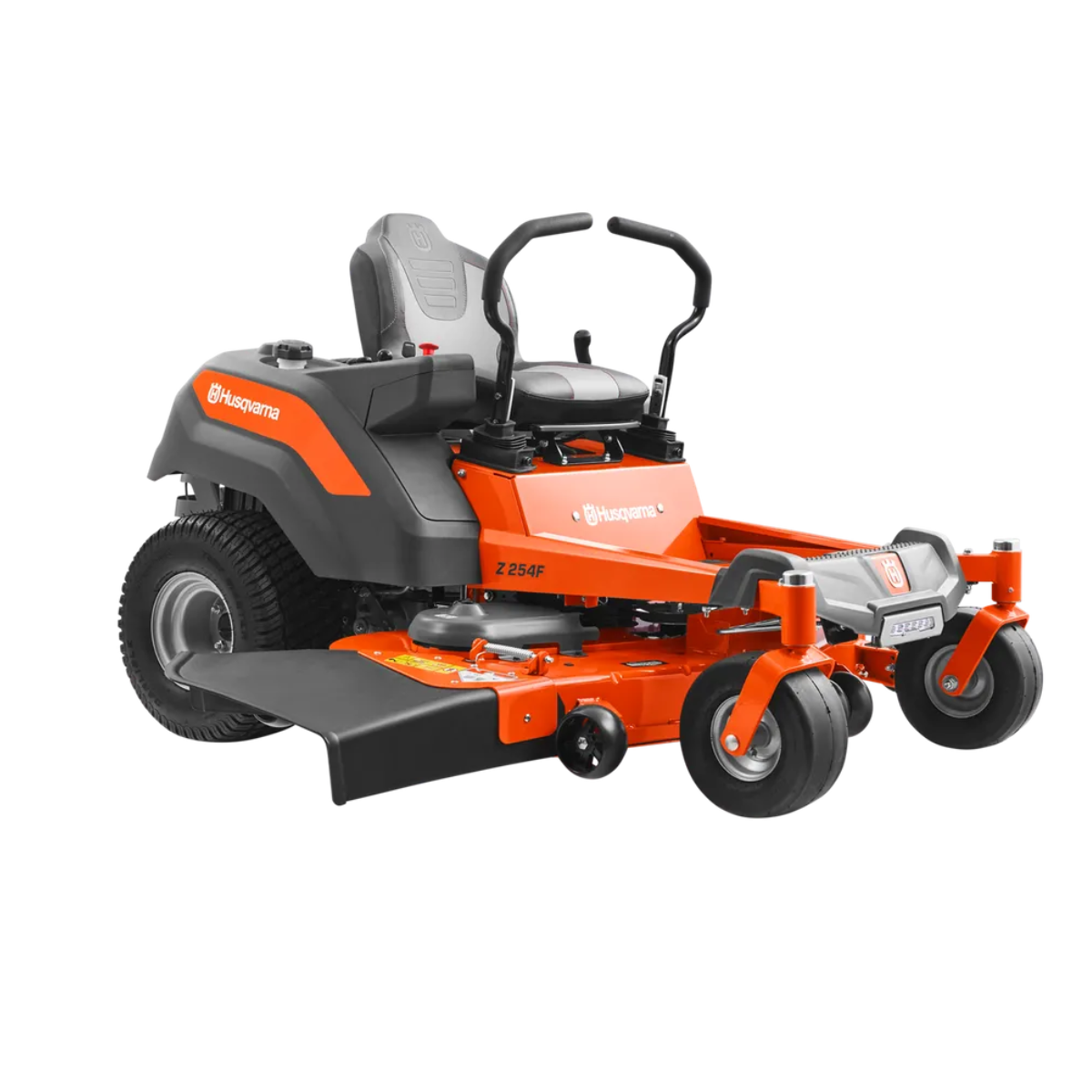
A zero-turn drives each rear wheel independently, so it pivots on the spot. You cut right up to a tree and carry on, instead of circling back for the bit you missed. On an obstacle-heavy acre the time saved is real – commonly a third to a half.
The trade-off is the front castor wheels. They steer by being dragged, which is why zero-turns lose traction on wet slopes and scuff turns on soft ground.
Where tractors still win
A lawn tractor steers the front wheels like a car. Less nimble, far more predictable on a gradient. It will also pull a trailer, a spreader, a dethatcher or a plough – most zero-turns are not built to tow.
If your property has slopes above roughly 15 degrees, or you want one machine that also moves mulch and snow, the tractor is the sane choice.
Sizing the deck to your lawn
- Under ½ acre – 30 to 36 inch. A 30″ Craftsman fits through a standard gate, which matters more than people expect.
- ½ to 1 acre – 42 inch. The default size for suburban lots.
- 1 to 3 acres – 48 to 54 inch. The Husqvarna Z248F sits right in this band.
- 3 acres and up – 60 inch, like the Toro Titan Max.
A wider deck is not automatically better. It cuts fewer passes but scalps more on undulating ground, and it has to get through your gate and into your shed.
Battery or petrol?
Battery zero-turns have become genuinely viable. The EGO Z6 and the RYOBI 48V both cut an acre or more on a charge, start instantly, need no oil changes and are quiet enough to mow early on a Sunday.
The limits are honest ones: run time is fixed, thick wet grass drains them faster, and a long recharge ends the day. Above two acres, or where grass gets heavy, petrol still wins.
Transmission is worth understanding
A hydrostatic transmission gives smooth stepless speed with a pedal, and is what you want. Gear-drive machines like the Craftsman R110 cost less and are perfectly fine on flat ground, but you shift to change speed and they are harder work on slopes.
Dual hydrostatic on a zero-turn means each wheel has its own pump – that is the standard arrangement and what gives the machine its turning ability.
The things that decide satisfaction
Not headline specs, but these:
- Seat – you will be on it for hours. High-back with suspension is worth real money.
- Deck wash port – lets you hose the underside without jacking the machine up. Doubles deck life.
- Grease points – sealed bearings sound convenient until they fail. Greasable spindles last longer.
- Turning circle on a tractor – anything above 16 inches means a lot of trimming.
Browse the range
See all 37 machines in Ride Mowers, or the walk-behind range in Handy Mowers. Everything ships crated and insured across the lower 48.
Tell us your acreage, your slope and your gate width, and we will narrow it to two machines.