

Walk-behind mowers split into three genuinely different machines, and buying the wrong type is the usual reason someone ends up hating a perfectly good mower. The question is not brand – it is what your ground is actually like.
Push, self-propelled, or field and brush?
- Push – you provide the movement. Light, cheap, reliable. Fine up to about a quarter acre of flat lawn.
- Self-propelled – driven wheels pull the mower along; you steer. The right answer for most people with a real lawn or any slope.
- Field and brush – a different machine entirely. Cuts saplings, brambles and waist-high growth that would stop a lawn mower dead.
When self-propelled stops being a luxury
Anyone can push a mower across a flat 50 by 50 lawn. Add a slope, thick grass, or a wet morning, and you are working hard for an hour.
The important detail is which wheels drive:
- Front-wheel drive – easiest to turn, because you tip the mower onto its back wheels and swing it. Loses traction going uphill.
- Rear-wheel drive – keeps traction on slopes and when the bag fills, which shifts weight backwards. Best all-round for uneven ground – the Troy-Bilt 3-in-1 RWD is a typical example.
- All-wheel drive – for genuinely steep or rough ground.
If your lawn is flat, front-wheel drive is more pleasant to manoeuvre. If it is not flat, buy rear-wheel drive.
Battery or petrol?
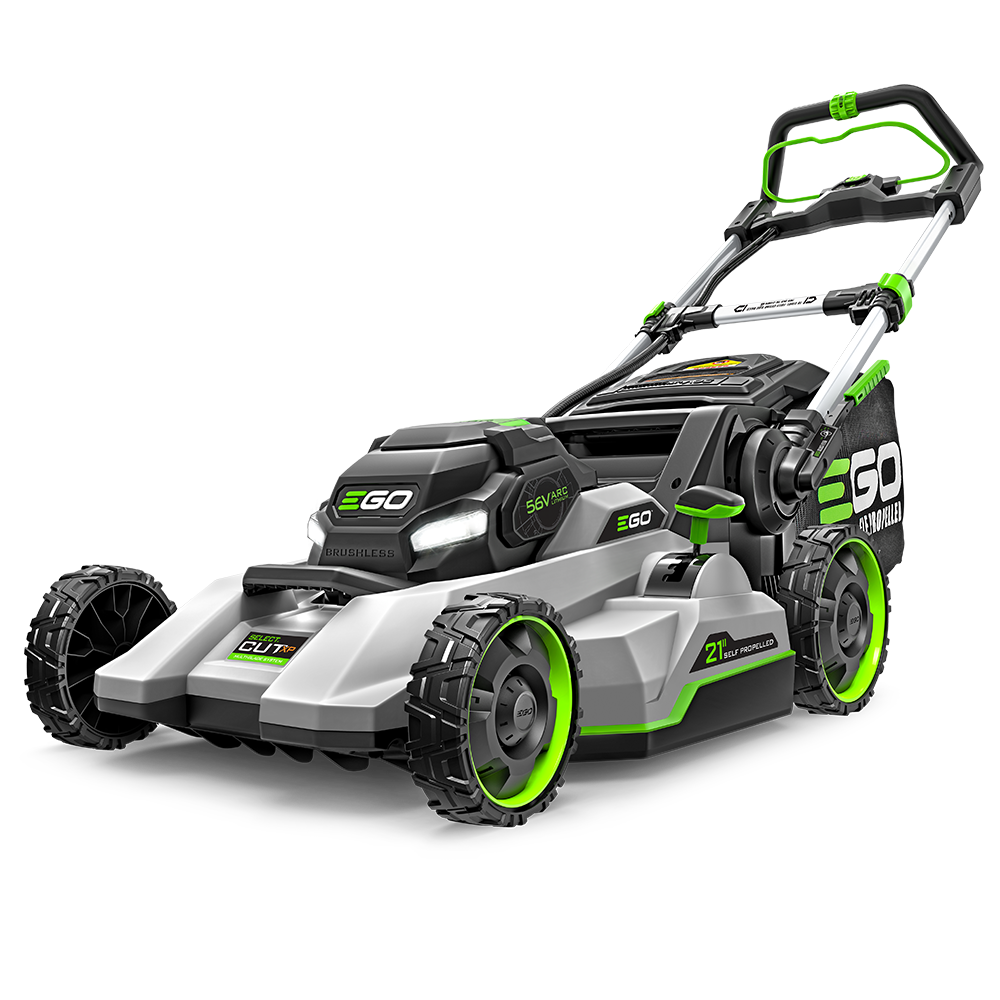
Battery mowers have taken over the walk-behind category for good reasons: no fuel, no oil changes, no pull start, no winterising, and quiet enough to mow at 8am without an argument. The EGO Power+ 21″ Select Cut XP cuts most suburban lawns on one charge and folds flat to store upright.
Petrol still wins in two situations: lawns over half an acre where you would need a second battery, and thick or wet grass that drains a battery quickly. Petrol also refuels in thirty seconds, where a flat battery ends the job.
For most quarter-to-half-acre lots, battery is now the better buy.
Deck width, honestly
A 30-inch deck like the Toro TimeMaster cuts roughly a third fewer passes than a 21-inch. On a half-acre that is a real saving in time.
The trade-off is weight and manoeuvrability. A wide deck is awkward around flower beds and will not fit through some gates. Measure your narrowest gate before buying anything over 21 inches.
Mulch, bag or side discharge
Most mowers do all three. Which you use matters more than people think.
Mulching returns clippings as fertiliser and saves you emptying a bag. It is the right default for a healthy lawn mown regularly. Bagging is for leaf clearance and the first cut after a holiday. Side discharge is for long grass you simply need knocked down.
The rule that actually matters: never remove more than a third of the blade height in one pass. Mow more often and mulch, and your lawn improves on its own.
When you need a field and brush mower
If you are looking at ground with saplings, brambles, or growth taller than your knees, a lawn mower is the wrong tool and will be damaged trying. A field and brush mower like the DR Power Pro 26 or the larger DR Pro MAX 34″ uses a heavy free-swinging blade and far more power to cut through material up to a few inches thick.
These reclaim overgrown land, maintain trails and keep pasture edges down. They are not lawn mowers and will not leave a lawn finish – that is not what they are for.
Leaf clearance
If your property has mature trees, a dedicated walk-behind lawn and leaf vacuum handles in an hour what a mower bag takes an afternoon to do, and shreds the material down for compost.
Browse the range
See all 10 in Handy Mowers, or step up to Ride Mowers if you are over an acre. Free delivery across the lower 48.
Tell us your lot size and how steep it is, and we will tell you which type you actually need.