

Almost every US state now uses the same three-class system for electric bikes, and the class determines where you are legally allowed to ride. It is the first thing to check and the thing most buyers discover last.
The three classes
- Class 1 – pedal assist only, motor cuts out at 20 mph. No throttle. Allowed almost everywhere a normal bike is, including most bike paths and many trails.
- Class 2 – throttle assist, motor cuts out at 20 mph. You can ride without pedalling. Allowed on most bike paths, but restricted on some natural-surface trails.
- Class 3 – pedal assist only, cuts out at 28 mph, speedometer required. Fastest legal class. Often barred from shared-use paths, sometimes requires a helmet or a minimum age.
If your commute includes a multi-use path, check the rules before buying a Class 3. Being the fastest bike on the road is no use if you are not allowed to take your route.
Anything above 28 mph
Bikes advertised at 30 mph or more, or with motors over 750 W, generally fall outside the three-class system entirely. In many states that makes them a moped or a motor vehicle – requiring registration, insurance and a licence, and not legal on bike infrastructure.
They can be excellent machines on private land. Just buy one knowing what it is, and check your own state’s rules rather than the marketing copy.
Motor position matters more than wattage
Hub motors sit in the wheel. Simpler, cheaper, quieter, and they push you along independently of your pedalling. Excellent for flat commuting and throttle riding.
Mid-drive motors sit at the cranks and drive the chain, so they use the bike’s gears. That makes them far better on hills – you can gear down and the motor gears down with you – and it centres the weight. They cost more and wear chains faster.
Hilly area? Mid-drive. Flat city? A hub motor saves money with no real penalty.
Reading range claims honestly
A quoted “up to 60 miles” is achieved on the lowest assist level, on flat ground, by a light rider in still air. Real-world range is commonly half the headline on higher assist.
The honest measure is watt-hours: volts × amp-hours. A 48V 14Ah battery is 672 Wh. As a rough guide, expect 20–25 Wh per mile with moderate assist, more with a heavy load, hills or fat tyres. That gives a realistic 27–34 miles from that battery.
Commuters should size for the round trip plus 30%, because charging at the other end is not always possible.
Matching a bike to a use
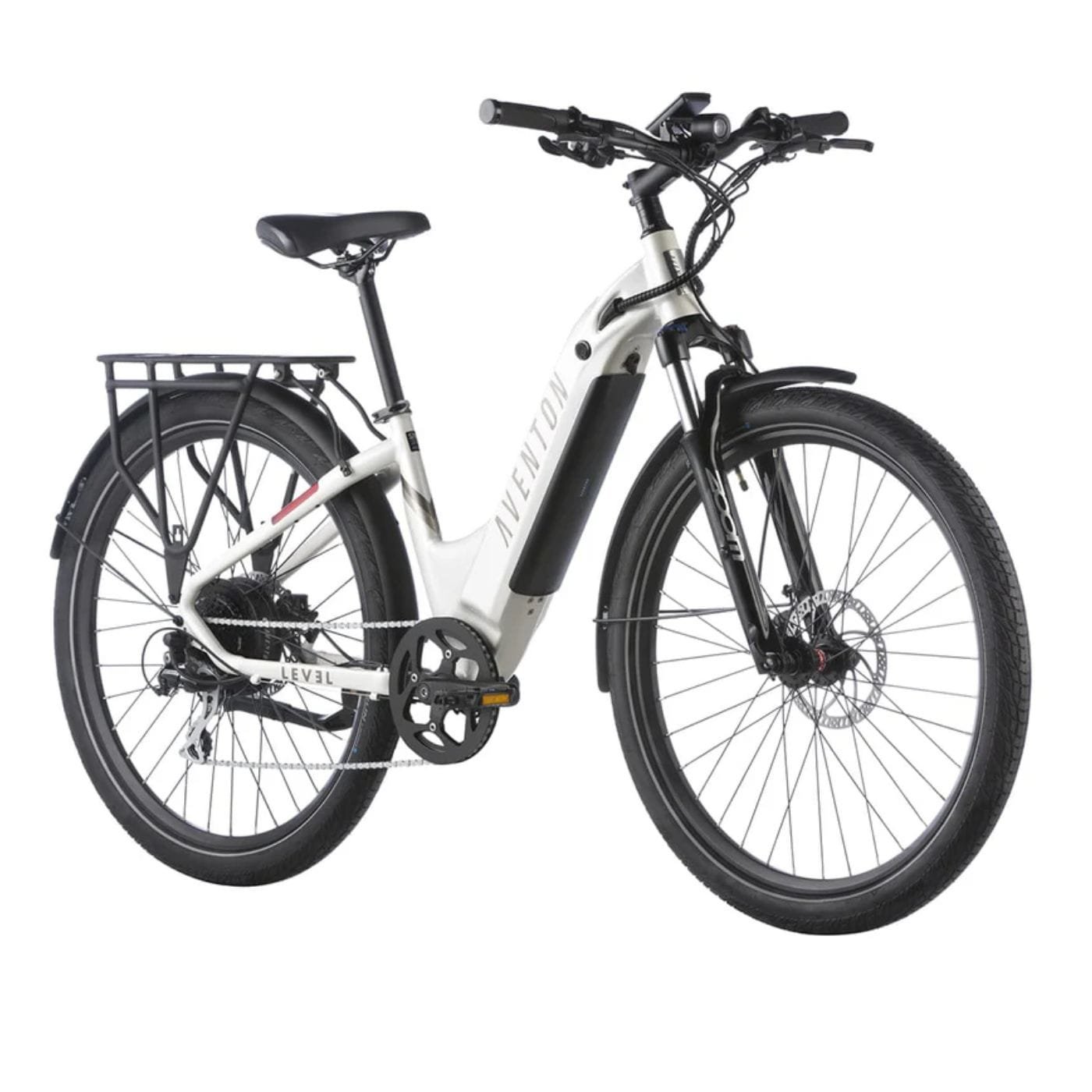
Commuting. Step-through frames, integrated lights, racks and fenders. Something like the Aventon Level.2 is built for the job rather than adapted to it.
Hauling. Utility bikes with long tails and heavy rear racks carry groceries, a child seat or a toolkit. The Rad Power RadRunner 2 is the archetype.
Mixed surfaces. Fat tyres float over sand, snow and loose gravel where a standard tyre digs in – the Aventon Aventure 2 covers this. They are slower and heavier on tarmac, so only buy fat if you actually leave the road.
Trail and moto style. Bikes like the Super73-S2 SE sit between bicycle and motorbike. Great fun; check local classification first.
The details that decide daily satisfaction
- Brakes – hydraulic disc, not mechanical. An e-bike with a rider is 80 lb or more moving at 20 mph.
- Removable battery – lets you charge indoors, which matters in winter and if you live upstairs.
- Torque sensor versus cadence sensor – torque sensing responds to how hard you pedal and feels natural. Cadence sensing is on or off, and lurches.
- Weight – 50 to 80 lb. If you must carry it up steps, this is the number that will decide whether you keep riding it.
- Certification – look for UL 2849 on the bike or UL 2271 on the battery. Battery fires are rare but real, and certification is how you avoid the bad end of the market.
Browse the range
See all 34 in Electric Bicycles – commuters, utility bikes, fat tyre and adventure models, shipped free across the lower 48.
Tell us your commute distance and how hilly it is, and we will narrow it down.