

Weber and Broil King dominate the mid-range gas grill market, and if you are standing between the two you will find a lot of opinion online and very little that explains the actual engineering difference. This guide covers the parts that change how the grill cooks and how long it lasts.
The short answer
Choose Weber if you want even, forgiving heat and the most reliable parts supply in North America. Choose Broil King if you want higher peak temperature, heavier cast iron grates and more burner control for the money.
Both are built to last a decade or more with covered storage. Neither is a mistake.
How the burners differ
Weber’s Genesis and Spirit lines use tapered stainless burner tubes under angled Flavorizer bars. The bars catch drippings, vaporise them, and shield the burner. The result is gentle, even heat across the grate and very few flare-ups. It is why a Weber is hard to burn food on.
Broil King uses Dual-Tube burners under a stainless Flav-R-Wave plate. Each burner is effectively two tubes, which puts more flame area under the grate and pushes peak temperature higher. If searing steak at 600°F+ matters to you, this is the meaningful difference.
Practically: Weber is the better roaster, Broil King is the better searer.
Grates
Broil King ships reversible cast iron grates on most models – wide bars on one side for steakhouse marks, narrow on the other for fish and vegetables. Cast iron holds heat far better than steel, which is what actually produces a sear.
Weber uses porcelain-enamelled cast iron on Genesis and stainless or enamelled steel further down the range. Easier to clean, slightly less heat retention.
If you cook a lot of red meat, grates matter more than burner count.
How many burners do you actually need?
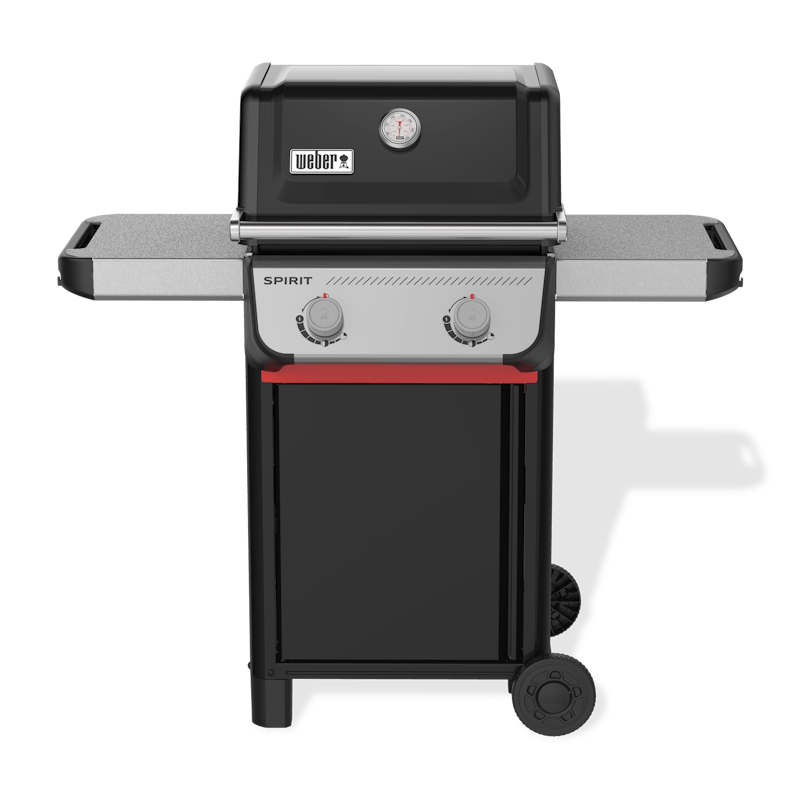
- Two burners – couples and small patios. Enough for four portions. The Weber Spirit Classic E-210 is the honest entry point.
- Three burners – the sweet spot for most families. Lets you run two-zone cooking, hot on one side, indirect on the other.
- Four to five burners – you are regularly feeding eight or more, or you want a side burner and a rotisserie.
Most people buy one burner more than they use. Two-zone cooking is the skill that matters, and you can do it on three.
Built-in or freestanding?
Freestanding carts move, store in a garage over winter and cost less. Built-in heads drop into a masonry island and look permanent because they are – budget for the island, the gas run and the ventilation gaps before you commit.
Unless you already have an outdoor kitchen designed, buy a cart.
Portable options
If the grill needs to travel, the category is small and clear. The Weber Traveler Compact folds flat on a cart, the Broil King Porta-Chef 320 gives you three burners in a suitcase format, and the Ooni Koda 2 is a different animal entirely – a gas pizza oven that hits 900°F in around 20 minutes.
Natural gas or propane
Propane is portable and needs no installation. Natural gas never runs out mid-cook but requires a plumbed line and fixes the grill in place. The conversion is not a matter of swapping a hose – the orifices differ – so buy the fuel type you will actually use.
What to ignore
Total BTU is the most quoted and least useful number on the box. A poorly insulated grill with high BTU loses the heat straight out of the lid. Cooking area, grate material and build weight tell you far more. As a rough rule, heavier is better.
Our picks
Browse the full range in Gas Grills – 119 models from Weber, Broil King, Sunstone, Grandhall, Enosign and Ooni, all shipped free across the lower 48.
Not sure which size suits your patio? Message us on WhatsApp from any product page and we will talk it through.